
[ad_1]
What do we do when we put on seat belt buckles with the familiar sound of ‘click’? We lock the seat belt in the buckle. We do it quite comfortably and don’t pay much attention to it. Could chemistry be that simple?
There is a molecular unit on one side and another unit on the other and they can be locked in the same way as belts and buckles? In fact, chemists have made the locking molecule so simple and it is more than can be imagined or isolated, and scientists have won the Nobel Prize for it. Not only that, but going forward, ‘click chemistry’ has been used inside human cells and they are used to map how cells work. This is the gist of the Nobel Prize in Chemistry for the year 2022.
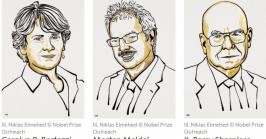
This year’s Nobel Prize in Chemistry has been jointly awarded to Barry Sharpless of Scripps Research, USA, Morten Medel of the University of Copenhagen, Denmark, and Caroline Bertozzi of Stanford University, USA.
Modern chemistry inspired researchers to create naturally available molecular structures in their laboratories. Mimicking amazing molecular structures in nature was indeed fascinating research for the youth of modern chemistry in the eighteenth century. This drive of research also resulted in the development of important pharmaceuticals. Creating natural molecules in laboratory test tubes proved worthy over time and chemists continued to work on it, gaining the ability to create amazing molecules with developed equipment.
However, there has always been one ‘but’ that haunts the world of chemistry, and that is the complexity involved in manufacturing natural molecules in laboratories. Complex molecules often involve multiple steps that are not only time-consuming and costly but also result in unwanted by-products. Removal of by-products is relevant and involves significant material wastage.
It is still okay to make small quantities in this process, but when it comes to mass production, chemists face a huge challenge. The 2022 Nobel Prize is really simplifying things where molecules can bind together quickly and efficiently in the desired form.
This need prompted many chemists to seek a simpler and more efficient way of manufacturing molecules. Making something simple can sometimes be more complicated and challenging. However, chemistry experts did not stop accepting it and found a new discoverer in the form of Barry Sharpless who has won this year’s Nobel. He got it for the second time. In the early 2000s Sharpless coined the concept of ‘click chemistry’ in which molecular building blocks can be quickly and efficiently linked together.
Barry Sharpless’s efforts were boosted when this year’s other Nobel Prize winner, Morten Medel, independently discovered one of the most important aspects in click chemistry, and explored the chemistry as a whole for that material. ‘Copper-catalyzed azide-alkyne cycloaddition’.
In his review paper published in 2001, Sharpless argued that chemistry had reached the point where it had to move to simpler reactions, where unwanted by-products are minimized. He argued that just a few good reactions are enough to assemble a large number of diverse organic molecules. In his new concept of click chemistry, Sharpless discovered new ways to design pairs of molecules that could only react with each other irreversibly.
Copper-catalyzed azide-alkyne cycloaddition
Azides are ions (negatively charged ions) consisting of three double-bonded nitrogen atoms. They usually exist as a functional group. On the other hand, alkynes are molecules that contain a triple bond between two carbon atoms. Chemical bonds are extremely important that bind the atoms in a molecule together. Double and triple bonds are chemical bonds holding different atoms in a molecule.
Azides and alkynes can react very efficiently when copper ions are added. This reaction has substantially changed the chemistry and is used to snap molecules together globally. In an example the Nobel Prize website has shown like the picture below:
 Image source: nobelprize.org
When azides and alkynes react they produce triazoles which are an important chemical building block found in pharmaceuticals, dyes and agricultural chemicals. Scientists tried this reaction before but they also produced unwanted by-products. Morten Meldl found that the copper ions added to the reaction system controlled this and that only one substance was created. Meldl first presented his results in the year 2001 at a symposium in San Diego and the following year he came up with a published book where he showed how this reaction could be used to bind various other molecules.
In addition to Meldl, Barry Sharpless also independently published a paper showing the copper-catalyzed azide-alkyne reaction in water and its reliability. According to Sharpless, this is the perfect click reaction.
As seen in the figure above, any two molecules that chemists wish to combine can now be easily done by introducing one molecule to the azide and the other to the alkyne and performing the copper-catalyzed click reaction.
This simple reaction facilitated the fabrication of many complex molecules in research laboratories and industrial applications. The importance of this is that click response can facilitate the production of new content for specific purposes. Click feedback has been used to create new content since its discovery.
‘Click chemistry’ and human cells
So, what about using it inside human cells? Since only the reactants are involved in the click reaction and do not touch other materials present in the reaction beaker, using it inside cells will ensure that only the desired material is involved and that the rest of the cellular processes are unaffected. This may be an unreliable idea in the treatment of complex diseases such as cancer.
Caroline Bertozzi, the third winner of this year’s Nobel, followed up on how the click reaction could be used for cellular purposes. Around the same time, Bertozzi was busy studying glycans, a complex sugar found on the surface of bacteria. Bertozzi was mapping glycans, a remarkably difficult task at the time.
In the year 2000, Bertozzi discovered an optimal chemical handle in the form of azide. He, in his important research in biochemistry, linked a fluorescent molecule to an azide, which was introduced to glycans. Notably, azides do not affect cells and, apparently, there is no harm in using them, even in living beings. At that time the click chemistry of Sharpless and Meldl was circulating among chemistry experts. But for Bertozzi, using it in this way in a cell was a problem because the copper ions involved in the click reaction can be toxic to cells.
Bertozzi was working quickly to find a substitute for copper to perform the azide-alkyne reaction in cells. Finally, in 2004 Bertozzi published the click reaction without copper ions.
Bertozzi then went on to further refine his click response so that it could be better used in the cellular environment. Along with him, several other biochemistry experts explored how biomolecules might interact in cells.
Bertozzi also studies glycans on the surface of tumor cells. Their study found that in some cases, glycans on tumor cells protect them from attack by the immune system (the immune system not only fights off invading agents, it also fights tumors inside the body). He and his colleagues have been able to create a new type of drug that can break down glycans on the surface of tumor cells. Clinical trials of this drug are being done on cancer patients.
In addition, several researchers have developed antibodies that can target tumor cells with the help of the click reaction. After the antibody is attached to the tumor, a second molecule that can click on the antibody is injected. The world has yet to see the potential of click chemistry and its use for new pharmaceuticals and new treatments.
[ad_2]